

October 22, 2025
Jungian Sandplay Therapy
Sometimes a client searches for words, but the feeling eludes description. Language can’t fully symbolize experience. What’s there feels less formulated, preverbal. This is where Sandplay therapy begins, offering space for the psyche to express itself in images.
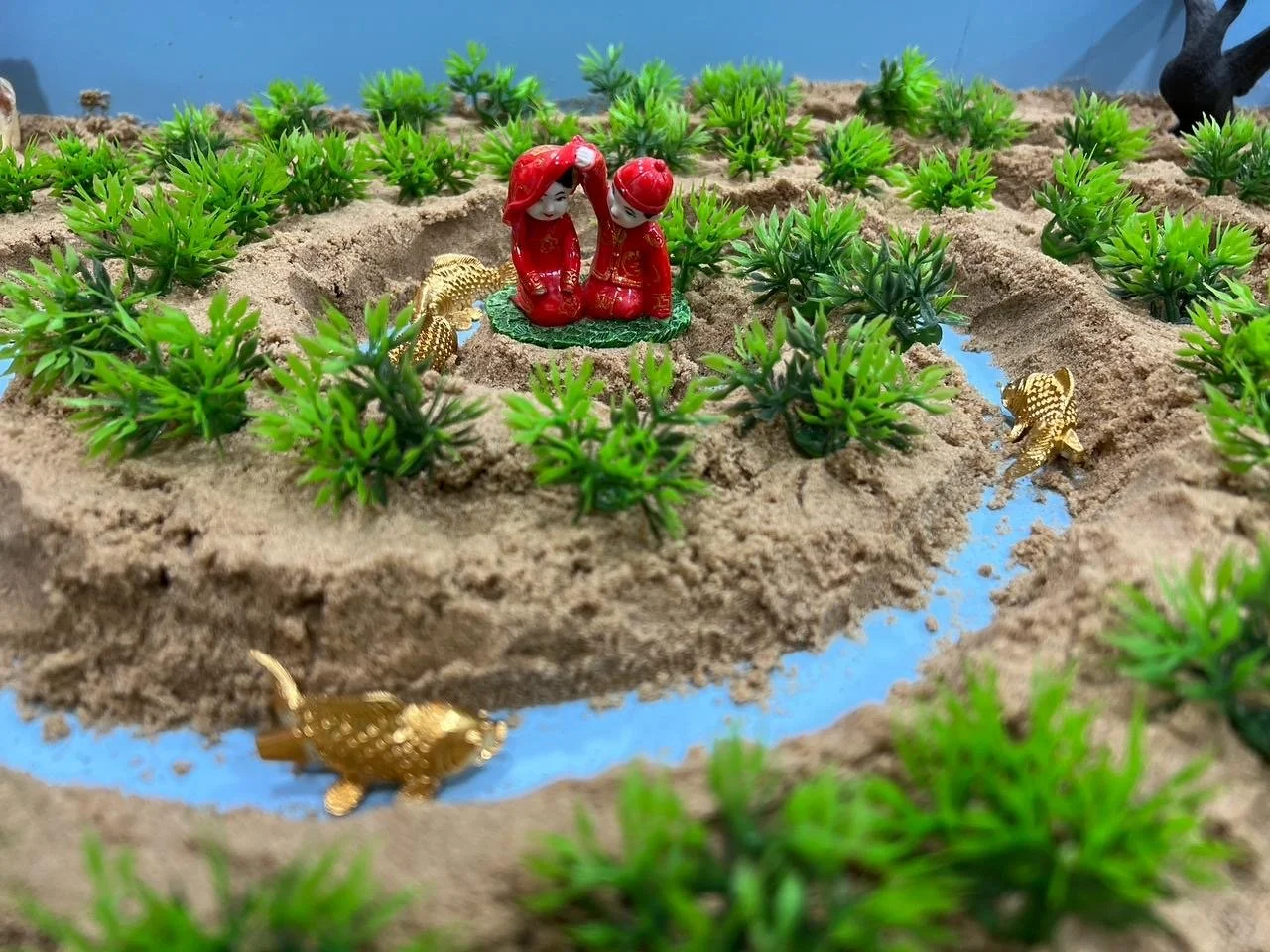
The structure is simple. A rectangular tray of dry sand. A selection of figurines, toys, and natural materials. The person working in the tray arranges the sand and places objects deliberately, one at a time, letting each remain and continuing to build.
The therapist is fully present but non-interfering. We witness and feel the images without intruding into the space. Things slow down. We tune in.
A Container for Movement
Sandplay was developed in the 1950s by Swiss therapist Dora Kalff. Mentored by Jung, she drew from analytical psychology, Margaret Lowenfeld’s World Technique, and Buddhist philosophy. She described the method as a “free and protected space,” where nothing is forced and whatever shows up is held with respect. Within that field, the psyche begins to find its own order.
Kalff believed everyone has an innate drive toward healing when given safety and freedom. The therapist’s task is to stay present while the unconscious finds expression. Meaning arises, not through interpretation, but through the image itself.
The Language of the Unconscious
A figure placed in sand carries more than an idea; it carries feeling, instinct, and memory. Martin Kalff describes this as “lunar consciousness,” an imaginal awareness distinct from the rational, verbal mode of mind.
The symbol, in Jungian terms, is not a sign that points to a fixed meaning. It’s alive, bridging conscious and unconscious life. The therapist refrains from naming it prematurely, knowing that words can fracture the image’s wholeness.
Toward Integration
Across sessions, trays tend to reveal a rhythm: chaos, tension, emergence, resolution. Kalff linked this to Jung’s process of individuation, the natural movement toward integration. Early trays typically feel fragmented, crowded, or barren; later ones may find space, symmetry, or dialogue. The change is visible. The sequence mirrors what Jung described in alchemical terms as nigredo, albedo, and rubedo — disintegration, clarification, and renewal.
Research
Research supports what therapists have observed for decades, including significant improvements in anxiety, depression, and trauma symptoms across children and adults (Wiersma et al., 2022). Further studies using neuroimaging suggest Sandplay activates brain regions linked to emotion, memory, and regulation (Akimoto et al., 2018).

The Therapist’s Presence
Kalff urged therapists to be “loving on a deep, inner level.” In practice, that means attending to the atmosphere: the silence, the texture of the session, the person’s breathing as a figure lands. During the process, the therapist’s job is to protect the space from intrusion so we can stay in relationship with the image. Interpretation comes later, if at all, and typically centers on the evolution across a series of trays rather than attempting to “decode” the symbolism of any single tray.
Interpretation comes later, if at all, and typically centers on the evolution across a series of trays rather than attempting to “decode” the symbolism of any single tray.
Sitting quietly as someone works, I tend to feel our connection deepen—emotionally, intuitively, and somatically.
Why It Matters
Sandplay offers a way of dropping in and exploring terrain that words can’t access. The tray becomes a stage for working through inner struggles and movements. It invites trust in a personal rhythm that knows how to restore balance.
Each tray is a living image, built, documented, and erased. What remains is a deepening relationship to one’s own center. Sandplay reminds us that, while words are vital signifiers and instruments, we also heal and evolve through embodiment and symbol.
Akimoto, Y., et al. (2018). Neural correlates of Sandplay therapy.
Freedle, L. R. (2024). Seven Key Tenets of Sandplay Therapy.
Freedle, L. R., & Morena, G. D. (2020). Foreword to Sandplay: A Psychotherapeutic Approach to the Psyche by D. M. Kalff.
Kalff, D. M. (2003). Sandplay: A Psychotherapeutic Approach to the Psyche. Temenos Press.
Kalff, M. (2006). Twenty-One Points to Be Considered in the Interpretation of a Sandplay.Journal of Sandplay Therapy, 16(1).
Wiersma, J. K., Freedle, L. R., McRoberts, R., & Solberg, K. B. (2022). A Meta-Analysis of Sandplay Therapy Treatment Outcomes. International Journal of Play Therapy, 31(4), 197–215.